
A GEO SEO audit checks five things in order: crawler access, rendering, structured data, llms.txt, then the buyer-question answers themselves. Five free tools, no signup, about 15 minutes total. Each step below shows what a pass looks like, what a fail looks like, and the fix.
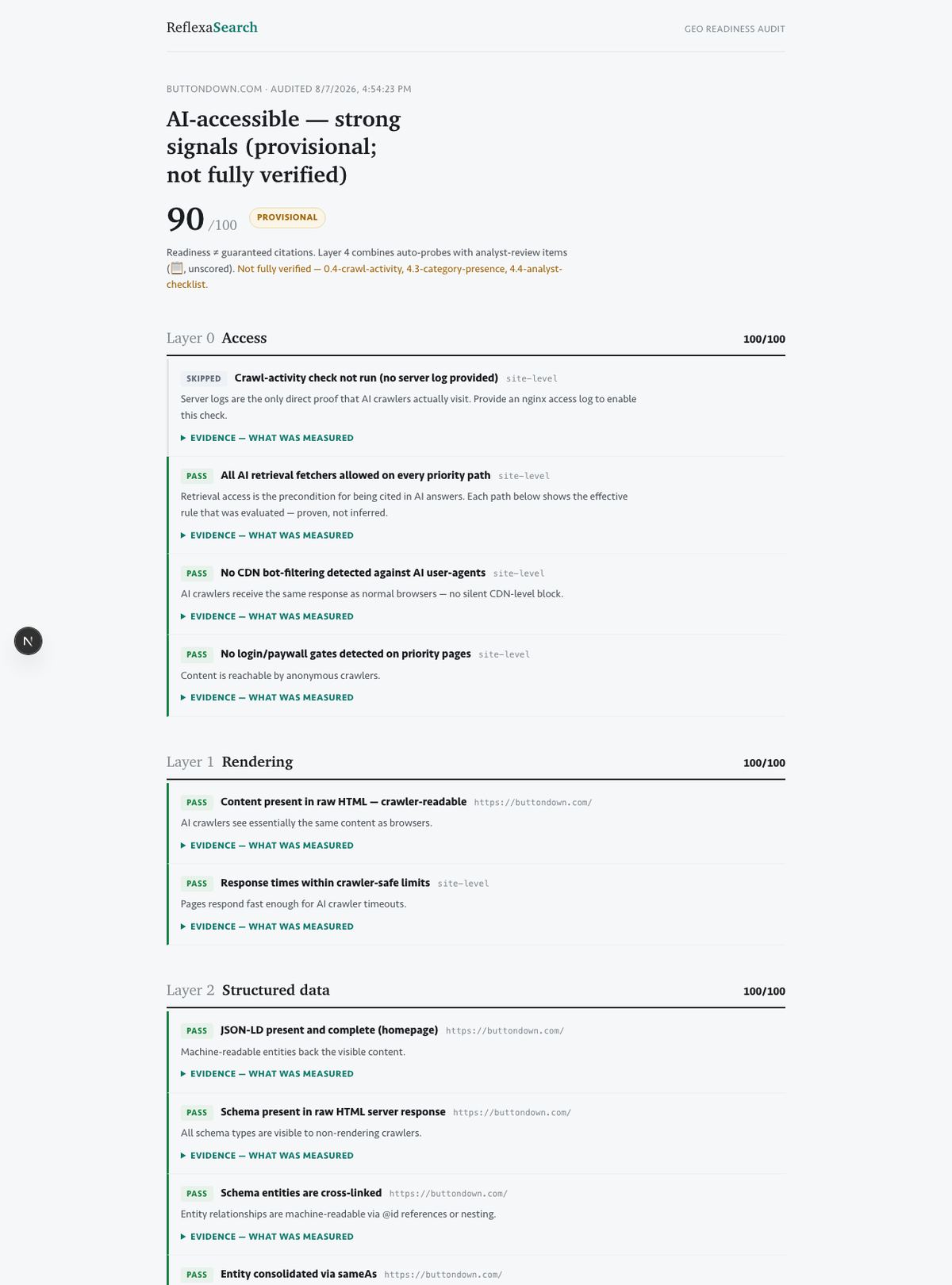
This is the do-it-yourself version of the same audit Reflexa runs on a domain automatically. It walks the checks in the order that actually matters, so searches for "geo seo audit", "ai seo audit" and "geo seo checklist" land on one answer instead of five disconnected tools.
It checks the same five-layer chain an AI engine works through before it can recommend you: access, rendering, structured data, content and authority, in that order, because a failure early in the chain cancels the layers after it. A site that blocks GPTBot in robots.txt never gets a fair read on its schema or its content, since the crawler never reaches either one. The full tour of the Reflexa toolkit covers how Recognition, What to Fix and the rest fit around this same chain once you're past the do-it-yourself version below.
Proof: the five-layer order, access, rendering, structured data, content, authority, is the method behind how the Reflexa audit works.
Bottom line: work the steps in order. Fixing content or schema before access is fixed wastes the effort.
Run the free AI crawler check to see your robots.txt verdict for GPTBot, OAI-SearchBot, ClaudeBot, Google-Extended and PerplexityBot, plus a live fetch with each bot's real user-agent to catch CDN or bot-wall blocks robots.txt never shows. A pass means every major AI crawler gets an explicit allow or no rule at all; a fail means a Disallow line, or a live fetch that returns a challenge page instead of your content.
Proof: Reflexa checked the robots.txt of 40 well-known companies on August 22, 2026 and found 7 (18%) blocked at least one major AI crawler, the full crawler access study.
The fix: remove the Disallow line for the blocked bot, or ask your CDN or bot-protection vendor to allowlist it by user-agent and published IP range.
Run the free what AI actually sees check, which diffs your raw HTML against the rendered page, because most AI crawlers read raw HTML and don't execute JavaScript. A pass means your title, H1, description and main copy already sit in the HTML before any script runs; a fail means a block of text, a price or a key claim only appears after rendering.
The fix: server-render or pre-render the content that matters most, the h1, the answer paragraph and any price or spec a buyer question depends on, instead of loading it client-side.
Run the free schema and entity check, thirteen checks on your homepage's JSON-LD, Organization and WebSite entities, name mirrored in visible text, sameAs profiles and an About page. A pass means every fact in your JSON-LD also appears in your visible copy; a fail means schema and page copy disagree, which forces an engine to guess which one to trust.
The fix: never let structured data claim something the visible page doesn't say. Update whichever one is stale so both match.
Run the free llms.txt validator to check an existing file against the llmstxt.org format, or draft one from your sitemap and page titles in a few minutes if you don't have one. It is an optional addition, not a ranking lever, so treat a fail here as a low-priority fix behind steps 1 to 3.
The fix: spend ten minutes on it once access, rendering and schema already pass, never before.
Run the free check at dashboard.reflexatechnologies.com/audit, which asks real buyer questions and shows, per engine, whether you're named, recommended or cited, with the full answer and its sources. This is the only step that measures the outcome instead of a precondition for it; steps 1 to 4 can all pass and an engine can still choose a competitor.
Why it's last: access, rendering, schema and llms.txt only clear the path. This step tells you whether the path led anywhere.
| Step | Free tool | Pass looks like | Fail looks like |
|---|---|---|---|
| 1. Crawler access | AI crawler check | No Disallow for GPTBot, ClaudeBot, PerplexityBot; live fetch returns content | Disallow line, or a bot-wall challenge page |
| 2. Rendering | What AI actually sees | Title, H1, answer and key facts already in raw HTML | Main copy or a price only appears after JavaScript runs |
| 3. Structured data | Schema & entity check | JSON-LD facts match the visible page, word for word | Schema and visible copy disagree on a name, price or fact |
| 4. llms.txt | llms.txt validator | Valid file, or none needed yet | Broken links, or missing sections against the format |
| 5. Buyer-question answers | Free check at dashboard.reflexatechnologies.com/audit | Named or recommended across most buyer questions, per engine | Absent, or a competitor named instead, with the evidence to show why |
Bottom line: a fail on any of steps 1 to 4 explains a fail on step 5. Work top to bottom.
None of this requires buying anything, and each step takes a few minutes:
Bottom line: five checks, fifteen minutes, no purchase required to find out where you stand.
A GEO SEO audit checks whether AI crawlers can reach your site, whether they see the same content a visitor does, whether your structured data is trustworthy, and whether ChatGPT, Claude and Perplexity actually name you for real buyer questions, in that order.
About 15 minutes for all five checks, using free tools that need no signup: four checks at reflexatechnologies.com/tools and the free Recognition and What to Fix check at dashboard.reflexatechnologies.com/audit.
A normal SEO audit checks rankings and technical SEO. A GEO SEO audit adds four checks a rank tracker can't run: AI crawler access, what AI sees without JavaScript, whether your schema matches your visible copy, and whether AI actually names you in an answer.
Fix access and rendering failures first. The audit runs in a chain, so an early failure cancels whatever the later steps would otherwise find, and a blocked crawler makes good schema or content irrelevant.
No. llms.txt is an optional, roughly ten-minute addition that some engines read. It never substitutes for crawlable HTML, working schema, or content that answers the buyer's question directly.
The free check runs the last, most important step: does AI actually recommend you. 3 minutes, evidence included.