
What to Fix is the Reflexa tool that turns a losing AI answer into a specific, evidenced change — not a single score. When Recognition shows a business missing from ChatGPT, Claude or Perplexity's answers, What to Fix runs the same five-layer audit — access, rendering, structured data, content and authority — and turns each failing layer into a plain-English finding: what's broken, the raw evidence, its severity, and the fix. Nothing is compressed into an anonymous number; a blocked crawler reads "Blocked," not a score. Here's what the tool actually shows, and why it's built that way.
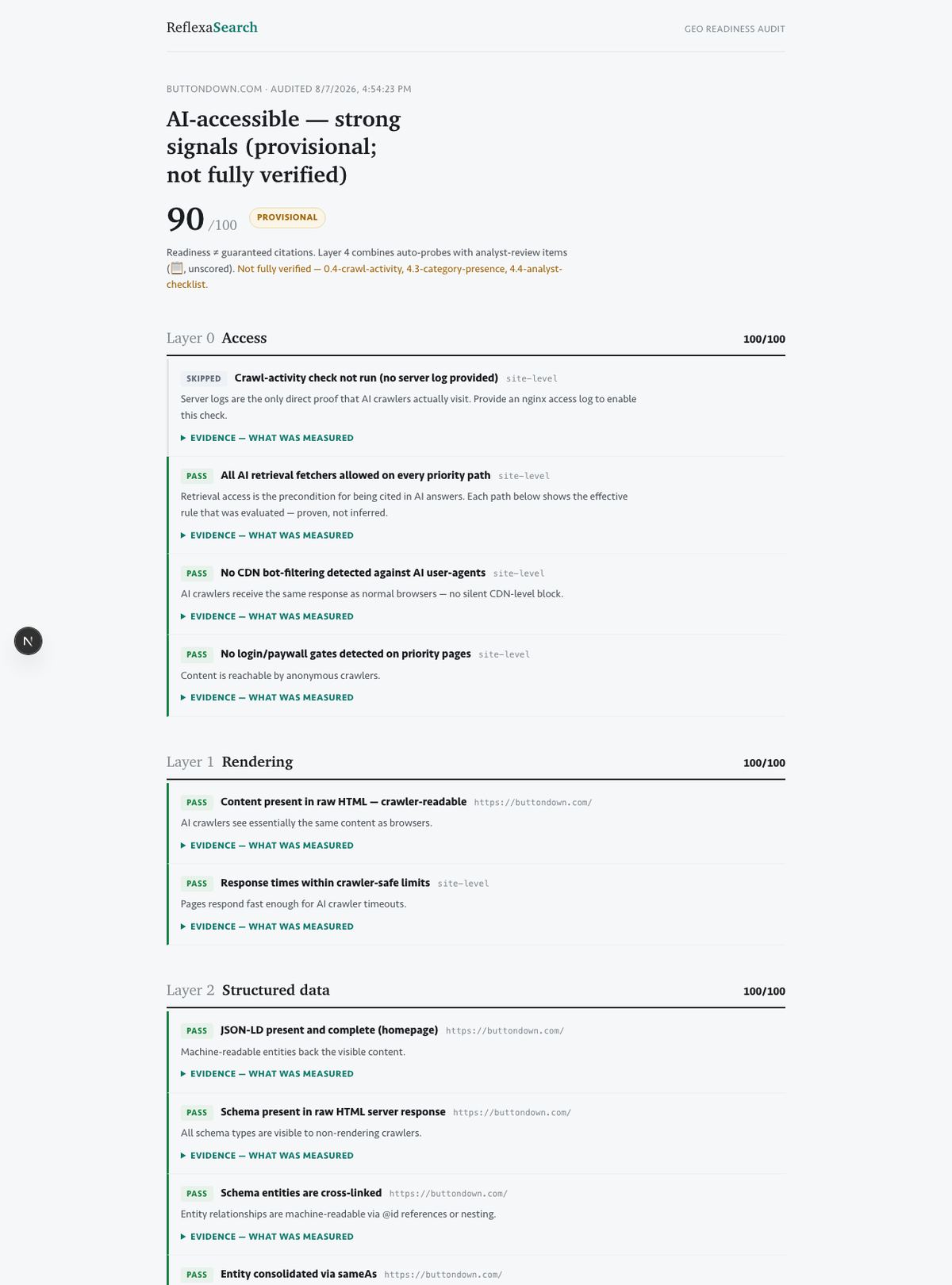
What to Fix is one of Reflexa's five tools — the one that turns a losing answer into a concrete change. Recognition shows whether ChatGPT, Claude and Perplexity name a business on its real Buyer Questions; when the answer is no, What to Fix runs the underlying audit and explains exactly why, layer by layer. The full tour of all five Reflexa tools covers where each one fits in that sequence.
Bottom line: Recognition tells you that you're losing a Buyer Question; What to Fix tells you why, with the evidence attached.
What to Fix walks the same five-layer chain described in Reflexa's audit method — access, rendering, structured data, content structure and authority — and an early failure cancels the ones after it. A site that blocks GPTBot or ClaudeBot in robots.txt never gets a flattering score on structured data or content, because access is checked first and gates everything below it. The five-layer method, one layer at a time, explains why the order matters.
Proof: in Reflexa's own check of 40 well-known sites, 18% blocked at least one major AI crawler in robots.txt — an access failure no amount of good content further down the chain could fix.
Rule of thumb: if What to Fix flags access or rendering, fix that first — everything else waits behind it.
What to Fix never hands over a bare list of problems — each finding is labeled with a severity, the raw evidence behind it, an explanation of why it matters to AI specifically, and the concrete change to make. A missing Organization schema, for instance, isn't just flagged; the finding shows the JSON-LD Reflexa expected, what it found instead, and the exact block to add.
Do this: work findings in severity order — a single missing field cited by every engine matters more than ten cosmetic ones.
What to Fix refuses to compress a failing audit into one flattering composite number. If access or rendering fails, the report says so in plain language instead of generating a lower but still-numeric score that implies partial credit for something AI can't reach at all. Analyst-reviewed items are labeled as such and never folded into a machine-measured count.
Good news: a report you can trust beats a report that flatters you — a "Blocked" verdict is the fastest fix you'll ever make.
The loop that connects Reflexa's tools starts with a Buyer Question a business loses and ends with a shipped fix. Recognition shows that ChatGPT, Claude or Perplexity didn't mention a company on a specific Buyer Question; What to Fix explains which of the five layers is holding it back and what to change; and once the fix ships, Weekly tracking re-runs the same question and shows whether Mentions, Recommendations or Citations moved.
Shortcut: don't guess which fix matters — start from the Buyer Question you're actually losing and work backward through What to Fix.
What to Fix is built for teams that are already publishing content and still invisible to AI — not for teams starting from zero. If a site already ranks reasonably on Google but ChatGPT, Claude and Perplexity rarely name it, the cause is almost never "not enough content" — it's one of the five layers quietly blocking what's already there.
Do this: run the free check — it runs Recognition and What to Fix together on your own domain in about three minutes, evidence included.
The free check runs Recognition and What to Fix on your domain — 3 minutes, evidence included.