
A Reflexa report has five sections, and they're meant to be read in order: Recognition, Competitors, Sources, What to Fix, then Weekly tracking. Recognition tells you whether ChatGPT, Claude and Perplexity name your business at all; Competitors and Sources explain the surrounding landscape; What to Fix explains why, with evidence; Weekly tracking shows whether a fix actually moved anything. Here's what to look at first, what each number means, and what to skip past on a first read.
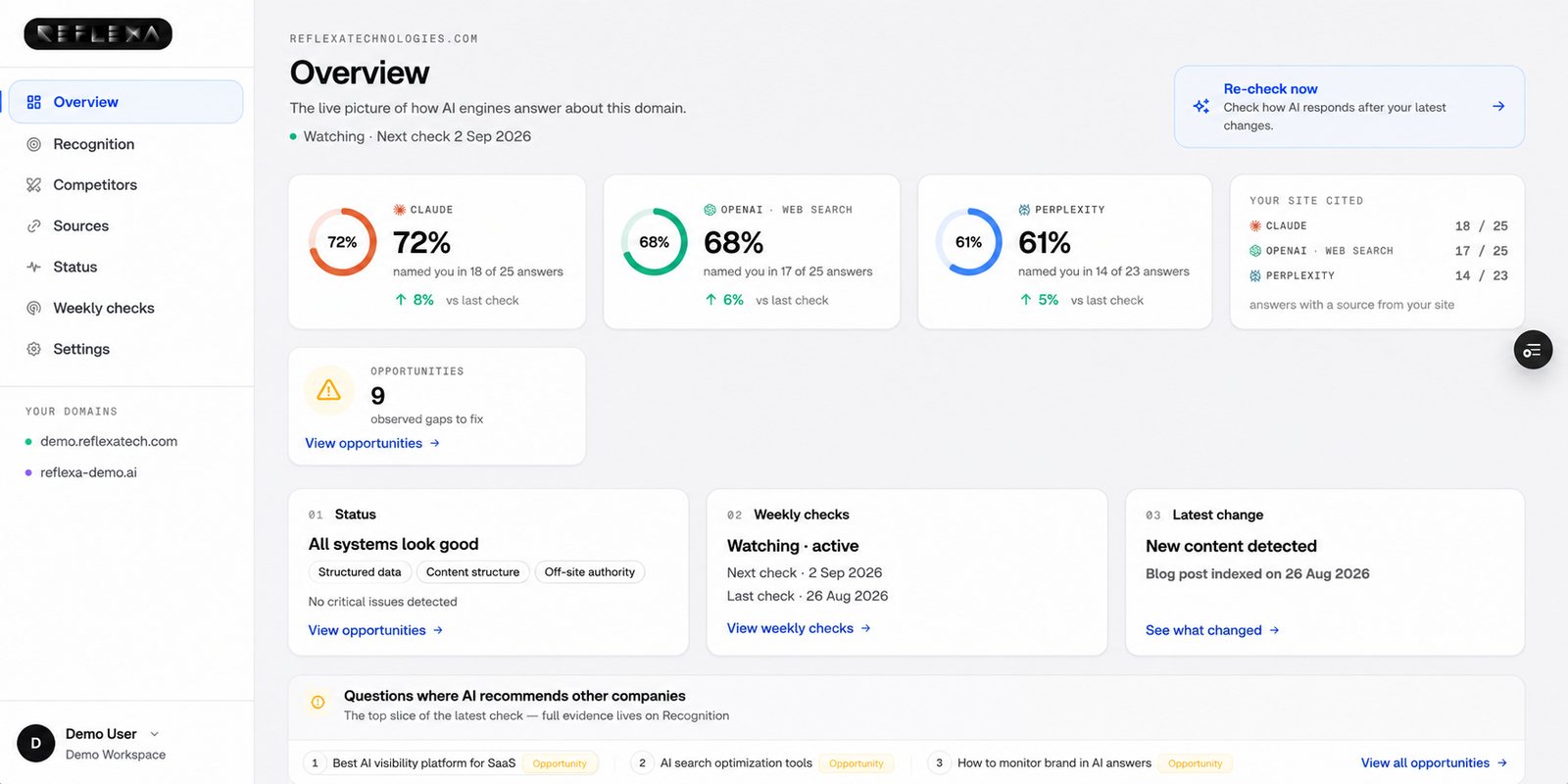
Reflexa's report mirrors the five tools that produce it — Recognition, Competitors, Sources, What to Fix and Weekly tracking — and each section answers a different question. There's no single composite number at the top standing in for all five; you read Recognition to see whether you're named, Competitors and Sources to see the landscape around that answer, and What to Fix to see why. The full tour of what each of the five tools does covers the reasoning behind splitting it this way instead of blending everything into one grade.
Bottom line: don't scan for a single number — read the sections in order, because each one only makes sense once you've read the one before it.
Recognition is the first section because it's the scoreboard — it shows how often ChatGPT, Claude and Perplexity name your business across the real buying questions your customers ask. Each engine gets its own count, shown separately: named you in 2 of 5 on Claude, 0 of 5 on Perplexity, for example. Underneath the counts sits every engine's full answer to every question, plus the sources it drew on for that answer — so a low number isn't just a grade, it's backed by the actual text AI produced.
Do this: read Recognition question by question before you look at the aggregate count — the pattern across which questions you lose is more useful than the total.
Competitors lists who AI names instead of you on the questions you lose, and Sources lists the pages AI actually cited while answering. Both sections report only what was observed on that run — how often a rival was named, how often a domain was cited — and never claim to know why AI chose one source or company over another. If the same handful of competitors or the same third-party domains keep showing up across questions, that's the landscape you're up against.
Rule of thumb: a competitor that appears once is noise; the same name across several questions is the one worth investigating.
Every finding in What to Fix carries the same four things — a severity, the raw evidence behind it, why it matters to AI specifically, and the concrete fix — and they're worth sorting by severity rather than reading in whatever order they're listed. What to Fix runs the same five-layer audit described in how the Reflexa audit works — access, rendering, structured data, content and authority — and an early failure in that chain cancels the layers after it, so an access finding is worth fixing before a content one even if the content finding is listed first. The full walkthrough of What to Fix goes deeper on how a failing layer turns into a specific change.
Do this: fix access and rendering findings before anything else — a structured-data fix can't help a page AI can't reach.
What to Fix never turns a failing layer into a softer-looking number — if access or rendering fails, the report says so in plain language instead of generating a lower composite that implies partial credit. Findings that needed a human analyst's judgment are labeled as such and kept separate from the layers Reflexa's engine measured directly, so it's always clear which parts of the report are machine-observed and which are reviewed.
Good news: if a finding reads "Blocked," that's usually the fastest fix in the whole report — everything behind it was waiting on that one thing.
Weekly tracking re-runs Recognition, Competitors and What to Fix on the same schedule and shows the movement between runs, because a single report is a snapshot and AI answers shift as the web and the models change. The section to watch after shipping a fix isn't whether the newest run looks good on its own — it's whether the count for the specific question you were losing actually moved, up or down, compared to the run before it. Available on the paid plans.
Shortcut: after you ship a fix, check the next scheduled run against the one before your change — not against the very first report you ever ran.
A first report is read top to bottom to understand where a business stands; every report after that is read as a diff against the last one. On a first read, Recognition and What to Fix matter most — they set the baseline and point at what to fix first. Once Weekly tracking has a couple of runs to compare, the most useful question stops being "what does this report say" and becomes "what changed since last time."
Do this: run the free check on your own domain — it produces Recognition and What to Fix together in about three minutes, with the evidence attached to every finding.
The free check runs Recognition and What to Fix on your domain — 3 minutes, evidence included.