
Reflexa is an AI visibility platform, and it's made of five tools — Recognition, Competitors, Sources, What to Fix and Weekly tracking. Each one answers a different question about how ChatGPT, Claude and Perplexity treat your business, from real answers to your buying questions. Here's what each tool shows and why it matters.
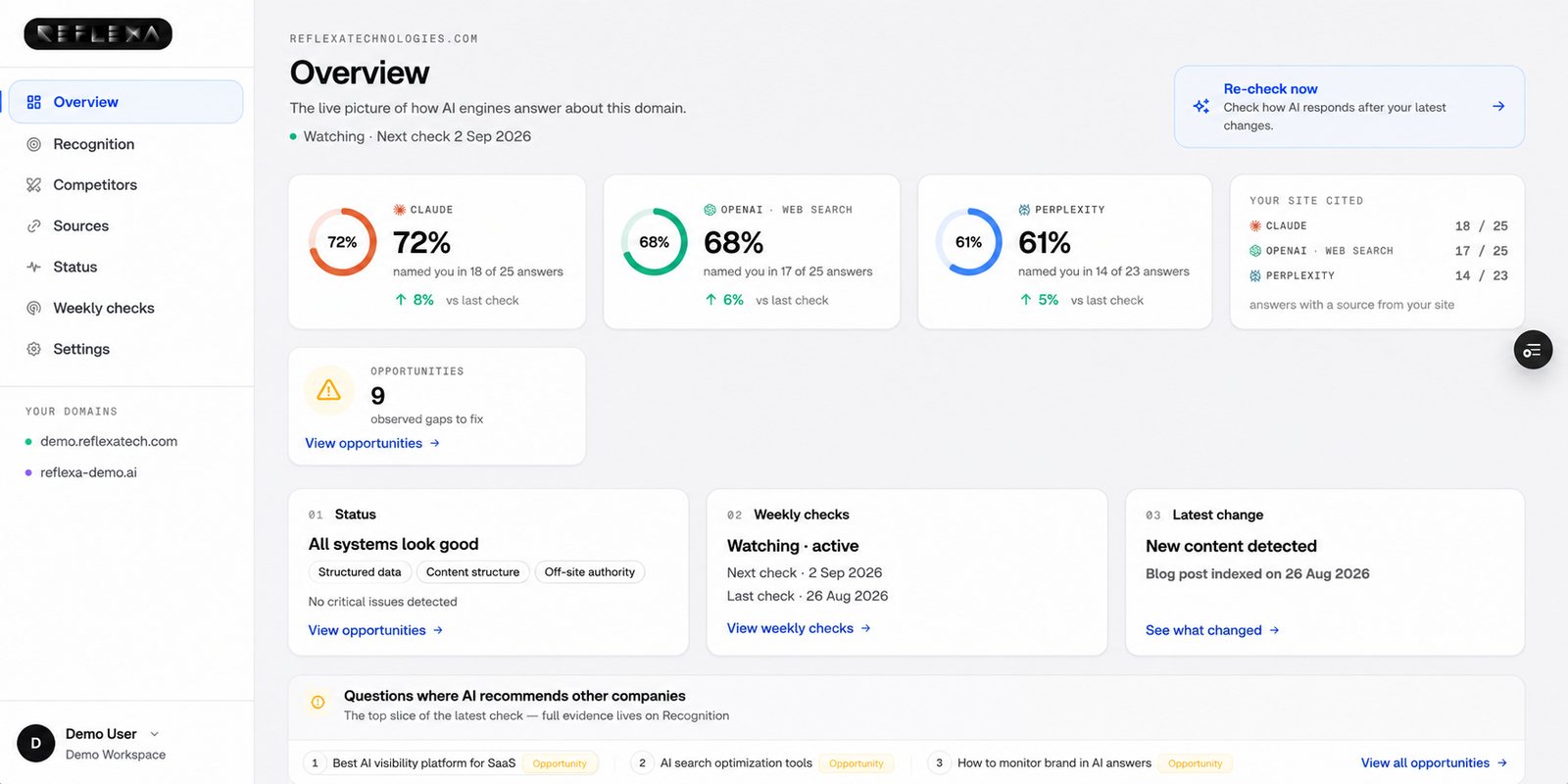
Recognition asks the engines the real buying questions your customers ask, and counts how often each one names you. You see a per-engine score — named you in 2 of 5 on Claude, 0 of 5 on Perplexity — and, question by question, every engine's full answer plus the sources it drew on. Engines are never blended into one number; each keeps its own count.
Why it matters: this is the scoreboard. Before you change anything, Recognition tells you whether AI recommends you at all — and shows the exact answers as proof, not a vague grade.
Competitors ranks the companies AI names when it doesn't name you. For every buying question where you're absent, it lists who won it, how often, and which questions — so you see the real shortlist AI hands your customers. Observed counts only: Reflexa never invents a market share or claims to know why AI chose someone.
Why it matters: you can't out-position rivals you can't see. Competitors turns “AI didn't pick me” into a named list of who it picked, and where.
Sources shows the pages AI actually cited while answering, grouped by site. You see which domains feed the engines in your category, how often each is cited, and whether your own site appears among them at all. Presence in the sources AI leans on is where visibility begins.
Why it matters: it's a map of where to show up. If the same third-party pages keep getting cited and yours never does, you know exactly where the gap is.
What to Fix runs the five-layer site audit alongside the answers and turns each problem into a concrete change. Access, rendering, structured data, content and authority — every finding carries its severity, the raw evidence behind it, and the fix. No single magic score; a blocked site reads “Blocked”, not “42/100”.
Why it matters: Recognition tells you that you're losing; What to Fix tells you why, and what to do about it — with the evidence attached.
Weekly tracking re-runs the checks and shows the movement run-over-run. AI answers shift as the web and the models change; tracking turns single snapshots into a trend, so you can see whether a fix actually moved recognition or a competitor is gaining. Available on the paid plans.
Why it matters: a one-off audit is a photo; tracking is the film. It's how you prove a change worked instead of guessing.
Every tool reports only what it can observe, with the evidence, and never blends two engines into one number. That's the design principle behind the whole toolkit: honesty as the product. You get a clear picture of how each AI engine sees your business — and a short list of what to change — without a black box in the middle.
Try it: the first check is free — run Recognition and What to Fix on your own domain and see the real answers in about three minutes.
The free check runs Recognition and What to Fix on your domain — 3 minutes, evidence included.